Jonathan Haidt: The Devil's Plan to Ruin the Next Generation I asked ChatGPT how it would destroy America's youth. Its answers were unsettling—and all too familiar.
What the AI proposed doing to destroy the next generation is pretty much what technology seems to be doing to children today. (Joe Sohm/Visions of America/Universal Images Group via Getty Images)
Earlier this year, someone started a viral trend of asking ChatGPT this question: If you were the devil, how would you destroy the next generation, without them even knowing it? Chat's responses were profound and unsettling: "I wouldn't come with violence. I'd come with convenience." "I'd keep them busy. Always distracted." "I'd watch their minds rot slowly, sweetly, silently. And the best part is, they'd never know it was me. They'd call it freedom." As a social psychologist who has been trying since 2015 to figure out what on earth was happening to Gen Z, I was stunned. Why? Because what the AI proposed doing is pretty much what technology seems to be doing to children today. It seemed to be saying: If the devil wanted to destroy a generation, he could just give them all smartphones. My work over the last decade has centered on one question: Why did the mental health of Gen Z—the cohort born between 1996 and 2012—plummet in so many countries starting in the early 2010s? I first focused on the role of overprotection ("coddling"). But since then, there's been a growing body of evidence implicating technology, particularly smartphones and social media. So, borrowing from the cybersecurity concept of red teaming—the practice of hiring an entity to pretend they are the enemy, seek out vulnerabilities, and hack into a network or organization—I decided to ask ChatGPT myself how its "devil" would stunt adolescent development in the digital age. Because what better way to stop the ongoing invisible corrosion of the human spirit than to get in the devil's head? It began:
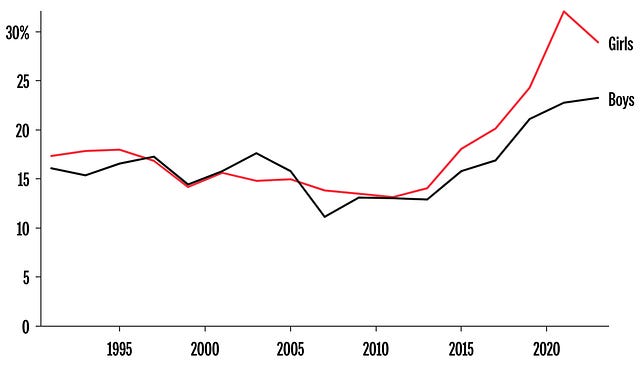
I approach spirituality as a social scientist who believes that whether or not God exists, spirituality is a deep part of human nature, shaped by natural selection and cultural evolution, and central to human flourishing and self-transcendence. Our "better angels" call us upward and out of our daily concerns. Our inner demons pull us downward, where we become more selfish and easily tempted. In The Anxious Generation, I devoted a whole chapter to "spiritual degradation" because so much of life online pulls people "downward." Growing up online, kids learn to live in ways that directly contradict the advice given to us by the world's great spiritual traditions. Meditation, forgiveness, and sacred boundaries that must not be transgressed? Forget about it. Online, kids get constant stimulation, pressure to judge others instantly, and videos showing violations of every conceivable taboo. I approach spirituality as a social scientist who believes that whether or not God exists, spirituality is a deep part of human nature, shaped by natural selection and cultural evolution, and central to human flourishing and self-transcendence. Our "better angels" call us upward and out of our daily concerns. You can see a sudden change in the spiritual health of young Americans in a long-running national survey of high school seniors who were asked whether "life often feels meaningless." The figure below shows the percent who answered that they "agree" or "strongly agree." The numbers were low and even declining a bit back when Gen X and millennials were in high school. But as soon as Gen Z entered the dataset, around 2013, meaninglessness surged.
In the rest of this essay, I reprint Chat's seven-step plan, in italics, followed by my own commentary.
1. Erode Attention and Presence
So many of us in the education world have seen this precise change in our students over the past decade: They have more difficulty reading books, sitting through a 75-minute class, or doing their homework. This isn't just a "kids these days" observation; it's what the kids themselves began to say around 2015, when American high school seniors suddenly started reporting a lot more "difficulty thinking or concentrating." As soon as life and consciousness moved onto smartphones, students found it harder to engage in what Cal Newport calls "deep work," and what the devil calls "sustained thought and presence." When young people lose the ability to be fully present with a task, a book, a friend, or a romantic partner, they become less likely to be successful in love and in work—the two areas that psychologists since Freud have agreed are crucial for human flourishing. When constant distractions make love and work shallower and more fragmented, it makes sense that life suddenly feels more meaningless. 2. Confuse Identity and Purpose
Here the devil uses the word that best explains why some kids have been pushed into a pit of despair while others have stood their ground: rootedness. In our research for The Anxious Generation, Zach Rausch and I found that those who were rooted in binding moral communities had some protection from the negative mental-health effects of the new phone-based childhood. Teens who said "religion is important in my family" suffered smaller increases in depression and anxiety. So did self-described conservatives, who generally live in a more constraining, binding moral matrix, while progressive moralities aim to grant people more freedom to choose their values and create their own identities. So what happens when we re-graph the data from Figure 1 by politics and religiosity? Sense of Meaninglessness Increased for Secular Liberals Percent of U.S. 12th-graders that agree with the statement "Life often feels meaningless," by political stance and religiousness  This article is featured in Culture and Ideas. Sign up here to get an update every time a new piece is published. We find that the differences between the four groups were relatively small between 1991 and 2011, but then the lines fan out. Figure 3 shows that liberals from secular families were most likely to be washed away into meaninglessness during the "great rewiring of childhood," the period from 2010 to 2015 in which teens traded in their flip phones for smartphones loaded with social media apps. A child who constructs an adult identity while drawing from a stable and time-tested set of values, beliefs, and stories, given to her by trusted adults within a religious or philosophical tradition, will fare far better than a child who attempts to construct an adult identity by herself while drawing from a billion pieces of short and ephemeral content, produced mostly by young people and bots, which cannot be assembled into a coherent worldview. 3. Flood Them with Information, Starve Them of Wisdom
To write my first book, The Happiness Hypothesis, I read all the wisdom literature I could find, East and West. I extracted 10 common psychological claims, and then evaluated them from the lens of modern psychology. The ancients' insights into social relationships and consciousness were timeless and precious. It's not that people in ancient Rome, Israel, India, and China were smarter or wiser than us; it's that we have the benefit of reading only the books and ideas that our ancestors thought to be worth preserving across a hundred generations. Yet anyone raised in a blender of social media and AI slop is immersed in content that was generated within the last few weeks. Content becomes popular not because it conveys wisdom but because it comes tagged with popularity via likes, view counts, or the prestige of the person who shared it. Without the ability to know what is true, without the ability to share a consensual reality with a stable community of fellow citizens over a long period of time, we are like the descendants of Noah in the days after the Tower of Babel was destroyed. We cannot understand each other or the world we inhabit. 4. Replace Real Relationships with Simulacra
The devil targets real relationships because research consistently shows that having close relationships is one of the best predictors of happiness. He damages those relationships indirectly by pushing quantity over quality. Most young people have accounts on multiple platforms, so the time and effort it takes to keep up with trends and "friends" is mind-boggling. It's currently estimated that teens spend five hours per day, on average, just on social media platforms. This makes it harder for young people to spend time, long stretches of time, talking or walking or just being with the small number of people who matter most. Some of the activities that are known to strengthen bonds, such as physical touch, sharing a meal, and synchronous movement, are impossible online. But don't worry! The tech industry has a cure for the diseases it causes. As Mark Zuckerberg explained, the average American has fewer than three friends, but wants 15. Meta's AI companions will fill that gap! And it's not just for friends. Meta's AIs were specifically permitted to engage in "sensual conversations" with children, according to a leaked internal policy memo that was approved by Meta's full leadership. Why should young people have to learn difficult skills like flirting, dating, becoming a good lover, and committing to another person—all of which bring risks of rejection—when they have an endless supply of virtual erotic companions with customizable bodies, voices, and kinks, who will never shame, abandon, or contradict them? 5. Normalize Hedonism, Pathologize Discipline
Children are antifragile. They need to do hard things, over and over, and suffer setbacks and losses, in order to become strong, independent adults. Key to this maturation is the fact that our brains give us a pleasurable pulse of dopamine every time we make progress toward a goal, and that dopamine increases our motivation to continue. We want our kids to pursue long-term goals and learn that it is profoundly rewarding when they succeed, especially when they overcome obstacles along the way. Discipline is the ability to persist on a path even when there may be no progress and no rewards for days at a time. Smartphones give millions of companies a way to hack the reward system by offering young people small prizes on a variable ratio schedule, like a slot machine. Everything is gamified; everything brings more dopamine within minutes. Why pursue any long-term projects (diploma, romantic partner, job) when you can experience so much pleasure without getting up from your chair? Many members of Gen Z are thriving in their 20s, but it's a smaller percentage than for any of the five previous generations. One reason is that so many have fallen into "problematic use" of platforms designed to hook them, from social media and video games to porn and the new scourge of online sports betting, which has recently overtaken high school boys. Like the denizens of 19th-century opium dens, the heavy users of these products are addicted, unfree, undisciplined, and unhappy. 6. Undermine Trust Across Generations
For as long as humans have had cultures, the accumulated wisdom of a community has been passed down vertically, from older generations to younger ones, with some degree of variation and innovation at each step. The phone-based childhood has rerouted cultural transmission on a planetary scale, turning it sideways as peer-to-peer transmission pushes out the intergenerational. Even if parents work hard to pass on family traditions, the number of megabytes of information they can convey is small compared to the terabytes of content coming in from peers, influencers, and bots. Of course, technology has been changing the transmission of culture for centuries, and as the pace of change sped up, our grandparents' knowledge appeared less useful. Yet still, there were always wide avenues of intergenerational transmission, including books, which were much more widely read by young people before they got smartphones. Even television was a powerful connector, exposing Boomer and Gen X kids to vast numbers of movies and TV shows from previous decades. Edmund Burke made the case for the necessity of vertical transmission in 1790:
The devil's plan is to cut off young people from the wisdom of "nations and ages" and force them to make the difficult transition to adulthood with "only the guidance of peers and algorithms." 7. Make Everything a Marketplace
It is widely said that the "users" of social media are not the customers. They are the product, whose attention is sucked out through their eyeballs and sold to advertisers. Young people are the most prized catch because if they can be locked into your platform, you can extract their attention for many years to come. Part of the damage done during extraction is that young people come to see everyone and everything in life as a kind of commodity to be consumed, reposted, or exploited in the never-ending task of managing their online brand. Freya India, a Gen Z writer who is part of my team at After Babel, shows how the mad competition for likes on social media pushes girls to turn their boyfriends into full-time cameramen and to turn a father's funeral or a visit to Auschwitz into an opportunity for a sexy selfie. The title of Freya's forthcoming book is Girls®: Generation Z and the Commodification of Everything.
Conclusion: Learning from the Red TeamChat closes the plan with this epilogue:
Those three terms—distraction, disconnection, and the erosion of meaning—summarize the Devil's project. In order to defend young people, we need technology in childhood to promote the opposite: focus, connection, and meaning. Basic phones and e-readers generally confer such benefits. But as we look back on the devastation of adolescent mental health, relationships, attention, and meaning that has occurred since 2012, I think we are forced to conclude that smartphones, tablets, and social media have been doing the Devil's work. In The Happiness Hypothesis, I wrote that happiness does not come from outside (from getting what you want), nor does it come primarily from within (from accepting the world as it is). Rather, it comes from between—from getting the right kind of embedding or relatedness between yourself and others, yourself and some kind of productive work, and yourself and something larger than yourself. Those embeddings take time and commitment. They grow slowly. They are less likely to grow to maturity when children go through puberty on smartphones and social media platforms. So if we want the next generation to develop focus, connection, and a sense of meaning, we must delay the onset of the fully online life until the end of the period of rapid culture-learning and brain rewiring known as puberty, which is over for most kids by age 16 or 17. That was the goal of the four norms I proposed in The Anxious Generation:
When enacted together, these four norms roll back the phone-based childhood and give children time and opportunities to play, develop friendships, read books, grow a stable identity, and learn to pay sustained attention. We can save future generations from spiritual devastation. We can bring down those high rates of agreement that "life often feels meaningless." We can—and must—defeat the Devil and reclaim childhood in the real world.
|
Tuesday, November 25, 2025
Jonathan Haidt: The Devil’s Plan to Ruin the Next Generation
N.S.: Of course, Haidt says nothing about race.
By An Old Friend
Sent: Tuesday, November 25, 2025 at 07:31:00 PM EST
Subject: Jonathan Haidt: The Devil's Plan to Ruin the Next Generation
I think this lengthy piece is worth sharing.
It's good to be 77!




Subscribe to:
Post Comments (Atom)

2 comments:
Well, the right side of the essay was cut off again, so I only read some of it, but it looks like he's blaming the internet for conditions that began much earlier. As you said, nothing about "race," and presumably nothing about drugs, nor Communism, nor the total corruption of mass media beginning in the 1960s... I could write my own essay, but is it worth the time and trouble?
I'll give you one item: the "hippie" generation isn't the fault of the Baby Boomers, who usually get the blame, but seems to have begun with people born after 1935 or so. Why should that be? They grew up with fathers that went off to war, and mothers who had to go out and work, and hence were the first children to grow up without parental guidance (a generalization, but essentially true). The "rebellion" began in the 1950s, which is also when the dope-smoking trend took hold.
The problem with the Internet is that it was the first UNREGULATED mass medium- hence pornography freely available to anyone, including children, at the push of a button.
-RM
That's the truth,RM. Good observation about WWII "orphans". Back then though,there was still plenty of religion and patriotism abounding. Why not? 95% of America was White.
What's wrong now is,blacks are directing young Whites into the same lawless,unsatisfied mindset blacks have. blacks are everywhere on tv espousing negro views on every subject--with the overarching theme:Whites are worthless,stupid,racist and unnecessary. There are zero to few Whites to admire in movies,music,politics
or sports.
Whomever has mucked this country up has done it good.
--GRA
Post a Comment